



PCR is no longer an optional experiment; it’s becoming a procurement mandate, and more brands are moving towards PCR materials to meet their sustainability goals.
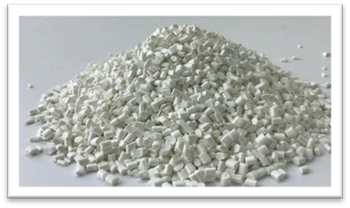
But here’s the catch: using PCR is not a simple “drop-in replacement.” It requires rethinking mould design, adapting process control, and tightening. Mould makers, suppliers, and OEMs are facing a new set of challenges in tooling and production!
Here’s what we’ve learned:
Key Challenges in Designing for PCR
- Material inconsistency: Fluctuating MFI can lead to short shots, flash, or burn marks, especially in multi-cavity tools.
- Impurities: Contaminants in PCR resins speed up tool wear, clog hot runners, and shorten life.
- Shot-to-shot inconsistency: Unstable melt flow affects product weight and performance; new IMM technologies can help address this.
- Aesthetic variability: Colour shifts and surface defects are frequent, particularly in transparent packaging
- Odour issues: Some PCR grades release unpleasant smells that clash with premium brand experiences.
- Cooling non-uniformity: Uneven cooling results in warpage and dimensional instability.
- Metal contamination: PCR resins can sometimes contain metal particles, posing a risk to hot runner systems. Nozzle filters and inline magnets are increasingly used to segregate metal particles.
- OEM pressures: Global brands are explicitly demanding PCR-compatible tooling as part of their sustainability scorecards.
- Thermal Degradation: PCR is more prone to yellowing, brittleness, and poor weld lines under high heat and shear
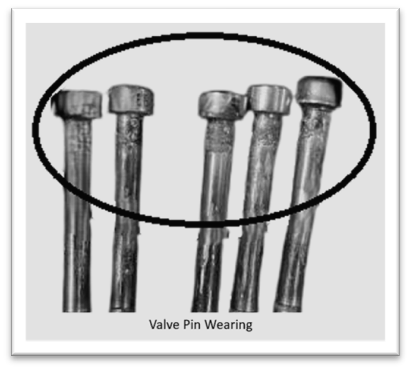
- Accelerated HRS & Mould Wear: The abrasive nature of PCR materials can cause rapid wear and damage to HRS & mould components, leading to increased maintenance frequency and reduced tool life and cost.
Design & Engineering Adaptations That Worked
Through years of qualification and trials, EIPL has built a playbook of what works in PCR-compatible moulds:
- Gate optimisation: Larger or valve gates for better flow control
- Material choice for steel: Abrasion-resistant grades like H13 and P20+Ni extend mould life.
- If the design allows, incorporate a gate insert into the mould to enable easy replacement in the event of wear.
- Apply a coating to the inserts to enhance the mould life.
- Advanced venting: Tackles gases, odours, and burn marks.
- Integrate nozzle filters and magnetic separators for cleaner melt flow
- Scientific injection moulding: Utilise principles like fill balancing, V/P switchover, and controlled cooling.
- Consider IMM technologies that enhance shot-to-shot consistency.
- Process Adjustments: lower barrel temperatures, gentle screw temperature profiles, and reduced residence time help mitigate thermal degradation. Additives like UV/antioxidants during compounding further support stability.
Maintenance & Quality Control
PCR tooling isn’t “set-and-forget.” Proactive maintenance is key:
- Test across multiple PCR batches, not just a golden lot.
- Adjust Cp/Cpk targets to reflect real-world material variability.
- Increase tool servicing frequency, especially for hot runners and vents.
- Maintain detailed tool performance logs for predictive maintenance.
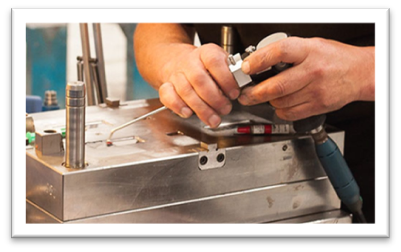
At EIPL, we’ve seen that discipline in tool data management is what separates successful PCR programs from high-cost failures.
IMM Technologies Ideal for PCR Materials
These technologies help ensure consistent quality when working with variable PCR resins:
- Arburg – Allrounder Series:
Modular design with closed-loop control and cavity pressure sensor options for high repeatability. - ENGEL – iQ Weight Control:
Automatically adjusts injection settings mid-cycle based on melt flow and part weight. - Krauss Maffei – APC Plus:
Adapts in real-time to changes in material viscosity for stable shot-to-shot performance. - Sumitomo – Smart Flow:
Maintains consistent shot weight, even with fluctuating resin properties
A number of other IMM suppliers have respective technologies to tackle the PCR moulding and its challenges.
The Road Ahead
Designing mould for PCR material is more than a sustainability checkbox; it’s about building future-proof tooling.
At EIPL, we’re helping partners hit their PCR targets and minimising the effect on performance, functionality or aesthetics of the components.

 Share
Share


