



Re-cycling? Nah, too old. Circular Economy? I am listening…
For many years and across industries, we have heard of manufacturing sectors producing X tons of scrap. Of which only Y amount is recycled while the balance Z is disposed of into landfills or oceans. This shrinks the concentric spiral of a product’s after life, thus creating tons of issues. Issues such as pollution, excessive resource consumption, natural resource depletion, inflation, etc.
Linear Economy
Let us first understand the concept of Linear Economy.
A product’s lifecycle starts with extracting natural resources, moulding and manufacturing them into desired products, selling and utilizing them, and finally throwing them back to nature. Thus, we extract pure resources while giving back waste to Earth. The result: Unfair resource use and distorted outlook towards nature.
Outcome of Linear Economy
The intention here is to make products and scrap them after utilization. Therefore, product design is geared to a short lifespan. The product is of poor quality, susceptible to breakage, not good looking, cheap, and often hazardous to life. All this has resulted in an unimaginable amount of pollution across the globe starting with the Industrial Revolution which began around 1750 A.D. For thousands of years before this revolution, the “pollution” term was not widely used. In the last 30 years or so, pollution is racing Planet Earth towards destruction.
Earth Overshoot Day
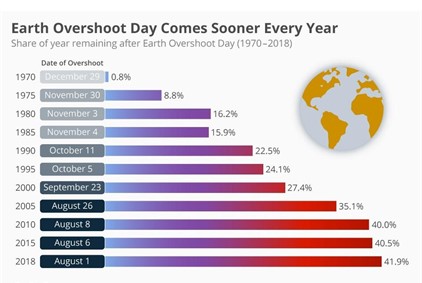
This is the date in every year when humans’ demand for Earth’s resources and services for that year surpasses what Earth can produce or recycle in the same year.
Earth Overshoot Day is derived by dividing the planet’s biocapacity (the amount of ecological resources Earth can generate that year), by humanity’s Ecological Footprint (humanity’s resource demand for that year), and multiplying it by 365.
Every year the date is advancing. While it was 29th July in 2019, 2020 delayed it to 22nd August perhaps due to the pandemic slowdown. However, 2021 saw it return to 29th July. This is alarming.
A better alternative to Linear Economy is Circular Economy! How? Let us see.
What is Circular Economy?
Moving past the current “get, build, and eliminate” resource-exhaustive industrial model, a circular economy targets remodeling of growth by focusing on positive socio-economic benefits. It mandates gradual decoupling of economic tasks from the consumption of finite natural/manmade resources and fabricating waste out of the system.
Supported by a shift to renewable energy sources, the circular model builds economic, natural, and social reserves. It is based on mainly three broad principles:
1. Design out waste and pollution.
2. Keep products and materials in circulation.
3. Regenerate natural resources.
In a circular economy, economic tasks create and re-create the overall system health. The concept considers the importance of working efficiently at all levels – businesses of all sizes, organizations, and individuals – domestic and international.
Shifting to a circular economy does not only mean modifications targeted at decreasing the negative effects of the linear economy. Instead, it illustrates a logical dynamic change that builds long-term pliability, generates business and economic opportunities, and creates socio-economic benefits.
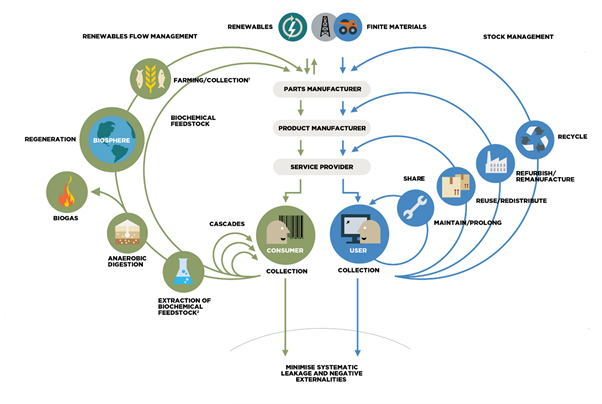
Outline of a Circular Economy “Butterfly Diagram”
Two cycles in a circular economy are:
Biological Cycle:
Food and other biological/organic substances (wood, jute, cotton, etc.) are modelled to feed back into the system after they are consumed. This happens through natural or artificial processes such as composting and anaerobic digestion. These cycles recreate living systems such as soil that contribute renewable resources to the economy.
Technical Cycle:
Reobtains and restores materials, components, and products through reuse, repair, re-manufacture, or recycling. Waste or obsolete output of a product at one location is the input for product manufacturing at another.
Foundational Stones of a Circular Economy:
1. Circular Economy Model:
Emerging and established companies both have to remodel and design their products so that they can be reused, recycled, and cascaded into the C.E. cycle. Such design requires advanced skills, data analysis, and new development methods. Critical areas for a successful C.E. design are raw-material, standard elements in a product, prolonged lifespan, easy facilitation of sorting post disposal, reuse and/or separation of products and/or material, and manufacturing feasibility design that considers utility of by-products or wastage.
Illustration
FMCG packaging companies have developed outer packaging for fragile products using mushrooms or other fibrous organic natural resources which: (a) are easily grown, (b) cause the least pollution to process into usables, and (c) are easily disposed to form manure for the same plant.
2. Latest Business Design:
Transition to a circular economy mandates innovative business models that either replace the existing ones or capture latest opportunities. Organizations with a large market share, skill set, and other requisites of a linear value chain can certainly contribute greatly to C.E. innovations and lead it into the mainstream by utilizing their size and technology. Realistically, the latest designs, materials, and components will be derived from emerging or existing entrepreneurs, who too can play an important role. Profitable C.E. business models and opportunities will motivate others to replicate across the globe.
Illustration
Many FMCG companies sell a starter box with a simple bottle and sachet of concentrated liquid. Customers must add the liquid and warm/tap water into the bottle to create a cleaning product. Now, each bottle and sachet can be used repeatedly. A bottle reused 19 times means 90% less packaging waste.
3. Reverse Rhythm:
Latest and advanced skills and techniques are required for cascading and returning materials to the Earth or to the technical cycle system. This includes supply chain logistics, sorting, warehouse, RM, power manufacturing, organic biology, and inorganic chemistry. With cost effective, decent quality collection and treatment process, and efficient stratification of end-of-life components, leakage of materials from the system will decrease, supporting C.E.
Illustration
A design agency identified a toaster for integration into a circular model by changing the business model. Toasters are commonly used in the region and thrown away when dysfunctional or damaged. People get a new one instead of repairing for reasons of cost and convenience. The company then manufactured three-block modular toasters so that customers easily replaced a damaged block and not the entire toaster.
4. Favorable Structure Circumstances:
In-order to mainstream material reuse and increased resource yield, market systems must lead with the foundation laid by policy makers, educational organizations, and experts. Favorable structure circumstances consist of: Quislingism, restructuring inducements, offering an acceptable set of global environmental norms, steering by example for faster scaling, and access to funding.
Illustration
Almost a decade back, a phone repair company in the developed world bought used phones from people who used to throw them away. Price was based on the phone’s condition. Then, the company repaired them and sold them at decent prices to call centres, salespeople, insurance dealers, etc. This helped everyone – the company, the old and new owners, and the environment of course.
Key Abettors for Circular Economy:
1. Acknowledge:
1. Comprehend: Circular Flow: A C.E. is a closed loop cycle with no start or end. Thus, theoretically minimal waste is released into nature. Business models need to align to this philosophy.
2. Revivify Thinking: Facilitating an ecosystem wherein every participant can sustainably thrive. Such an ecosystem must have direct support and facilitate growth and innovation. E.g. building a local production system that economically supports a local area and encourages the community to buy that local produce.
3. Utility Upturn: When product based companies integrate service in their offerings, product sales jump exponentially in a circular economy and forge stronger customer bonds. This can be achieved by understanding the customer’s needs and product limitations. E.g. a shirt manufacturing company collecting used shirts and upscaling it in the C.E.
4. Expanding: Comprehending everyday products and their manufacturing process will expand your perspective into input requirements. Thereby, you will understand the flows, network, and ecosystem conditions to integrate with.
5. Digitizing: With new technology coming up rapidly, understanding and integrating it with your service will help attain C.E. quicker. The outreach and feedback of your system will also be rapid, giving you real time data to act on.
6. Natural Learning: Over the recent past, biomimicry is on the rise. Basing your innovation on how living creatures use the forces and devices of nature will assist in rapid C.E. development.
2. Determine
1. Challenge Statement: To achieve a C.E., a unit must identify the problem and align with C.E. concept. This implies a multi-disciplinary approach.
2. Locate Circular Opportunities: Instead of using C.E. to alter the big picture, try attaining smaller targets which are more quickly achieved.
3. Designate Teams: As with all design aspects, multidisciplinary groups are important for a C.E. design for they deliver diversified knowhow and experience.
4. Acquire Stakeholders: Determine which investors are crucial for your idea and design – who can identify the potential. Create a proper plan to acquire stakeholders and keep them engaged.
5. Circular Business Design: Curate your business model by adding value for your customer, engaging with crucial partners, resource allocation, and selection of proper supply chain models. Widen your point of view for your business to succeed in a globalized world.
6. Strong Brand Presence: In today’s world, a brand determines a product’s value in the market, whether substandard or premium. People tend to go with a brand with an emotional connect. C.E., with its eco- and socio- friendly implications, is a powerful branding tool at present. Thus, defining the proper message will spread and sustain your brand.
3. Create
1. Customer Oriented Research: Make a product that is not just based on existing or primary customer needs, but on that of a wide range of people in that ecosystem of products and for the foreseeable future. This research will connect better with consumers and elevate your product or service.
2. Conceptualizing: Concept can be created based on critical brainstorming which generates multiple ideas converging with the one fitting into C.E. Keeping the door open for constructive criticism is important to nurture and select ideas.
3. Finalize Concept: Based on the company’s strength, goal, challenge to undertake, feasibility, and benefit to the ecosystem. C.E. should be the focus but can be side-tracked for certain bigger picture ideas.
4. Appropriate Material Selection: Material selected should be safe for the ecosystem and continuously up-scalable or recyclable.
5. Feedback Loop: A systematic feedback system will ensure regular, customer-need-based updates for the product or service. This will enable continuous process improvement which is beneficial to the environment, customers, and employees.
6. Prototyping: Any idea must be tangible enough for scalability. For that, prototyping is a cheaper and quicker way.
4. Launch
1. Release and Learn: After prototyping, is a pilot phase where your solution is launched on a smaller scale/ecosystem. The feedback system will help comprehend the ecosystem’s response to your product and its influence on staff, users, and the environment.
2. Product Journey Tracing: Circular economy products have a circular lifestyle. If you can map the journey you will understand where your product ends up versus where it was supposed to. Then undertake rectifications to make it more circular.
3. Cater to New Collaboration: Based on the performance of your prototype and pilot, you must look out for new investors or partnerships that want to collaborate with your brand and create value in the circular chain.
4. Build your Chronicle: Although you know that your product/service is circular, is the user also understanding the same? Many times, the product may not be fully circular in the ecosystem it is being used in. But the story of how the product can influence people’s life can change the whole game.
5. Line Up with Organization: Once the product is launched in pilot phase, you may have to restructure your organization, teams, and responsibilities to cater to upscaling. Also, employees need clarity on your goals and should be trained on it.
6. Ceaseless Learning: The embedded feedback system will help you continuously evolve and bring value to the ecosystem. This phase is important because many organizations fail if they think their product/service needs no tweaks.
For several years, Efficient has proactively supported products for its valued customers to achieve sustainability and circular goals. Our design experts collaborate with other specialists from various industries for continuous skill development and customer requirement satisfaction within the stipulated deadlines – all aimed towards creating a sustainably positive socio-economic impact.
To know more, get in touch with our experts through www.efficientinnovations.in
Article by,
Project Manager
EIPL

 Share
Share


